aipm-ai-architecture
Anatomy of a GenAI System
A generative AI feature is not just a model. It is a software system that collects a request, assembles context, calls one or more models or services, applies controls, returns an experience, and produces evidence about what happened. A failure at any layer can look like a “bad model” to the user.
A Product-Level System Map
flowchart LR
    A[User and interface] --> B[Application and orchestration]
    B --> C[Context and knowledge]
    B --> D[Model service]
    B --> E[Tools and business systems]
    C --> B
    D --> B
    E --> B
    B --> F[Guardrails and response]
    F --> A
    B --> G[Logs, evaluation, and monitoring]
The boxes are responsibilities, not required products. A small application may combine several responsibilities in one service; a larger organization may separate them across teams and vendors.
Follow One Request
- Interface: captures the user’s request, identity, and relevant settings.
- Application: checks access, loads state, and decides which workflow runs.
- Context assembly: combines instructions, conversation state, retrieved documents, structured data, and tool results within a limited context window.
- Model call: sends an input to a selected model with parameters such as maximum output length and randomness.
- Post-processing: validates, filters, cites, formats, or routes the output.
- Action or response: shows content to a person or requests an operation in another system.
- Telemetry: records enough information to evaluate quality, latency, cost, safety, and failures without exposing unnecessary sensitive data.
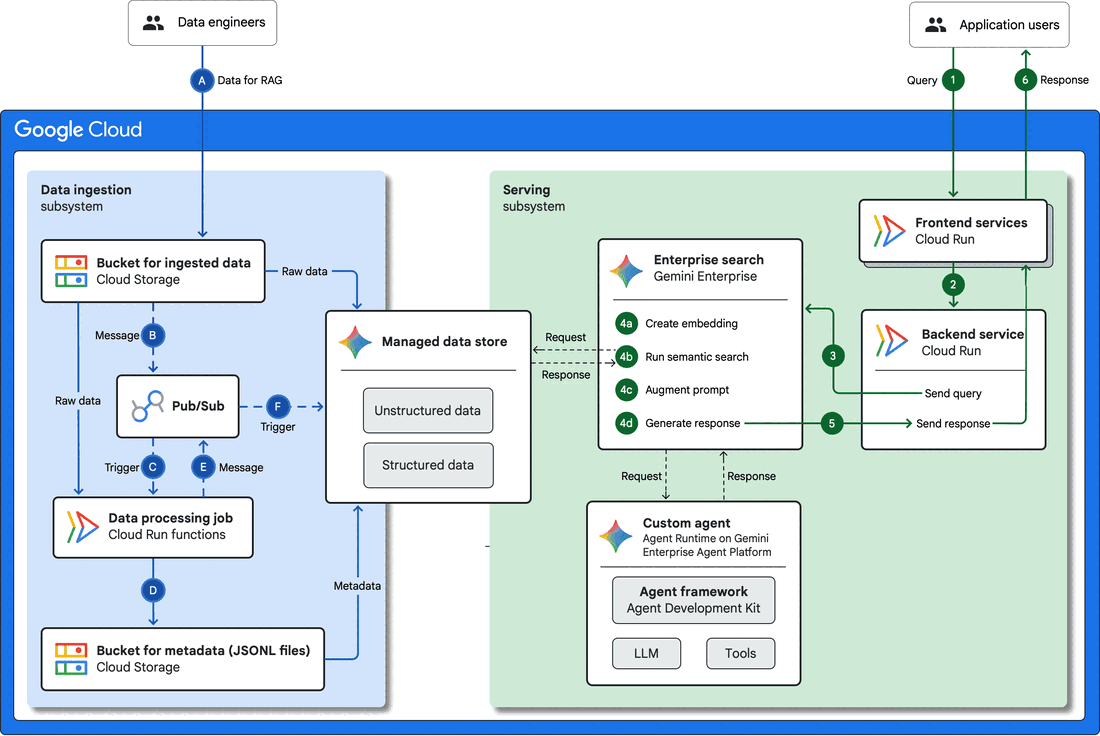
Source: Google Cloud, RAG infrastructure for generative AI, licensed under CC BY 4.0. The vendor services are examples; focus on the separation between ingestion and serving flows.
Two Flows, Not One
A knowledge-grounded application usually has at least two distinct flows:
- Ingestion flow: collect, clean, split, label, embed, index, version, and remove source content.
- Serving flow: authenticate the user, interpret the request, retrieve permitted context, generate a response, apply controls, and log the result.
Outdated answers may come from a failed ingestion job even when retrieval and generation work exactly as designed. Privacy leakage may come from retrieval permissions even when the model follows its prompt.
Architecture Questions for PMs
| Question | Why it matters |
|---|---|
| What decision or task does the system support? | Defines the required quality and acceptable error. |
| Which data crosses each boundary? | Reveals privacy, access, residency, and retention concerns. |
| Which component owns the final decision? | Prevents accountability from being delegated to the model. |
| What happens when a dependency is slow or unavailable? | Defines fallback and user communication. |
| Which versions produced this response? | Makes regressions reproducible. |
| How can a user correct or challenge the result? | Creates recovery and feedback paths. |
Architecture Evolves Across the Lifecycle
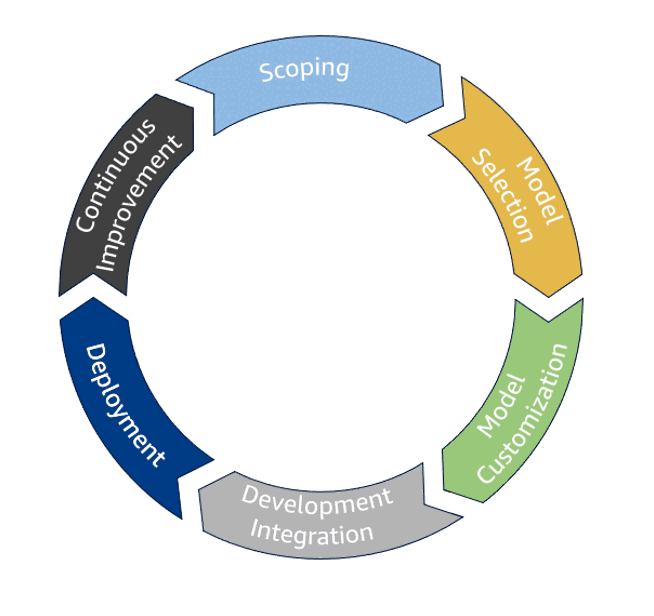
Source: AWS Well-Architected Framework, Generative AI lifecycle. The lifecycle is a useful reminder that model selection is one decision among scoping, customization, integration, deployment, and continuous improvement.
Architecture is not finished at launch. New user behavior, source content, models, regulations, costs, and failure evidence can change the appropriate design. Every significant component change should therefore identify what must be reevaluated and how the team can roll back.
Check Your Understanding
Question: A policy assistant gives an obsolete reimbursement limit. Why is “replace the model” an incomplete diagnosis?