aipm-ai-architecture
Tools, Workflows, and Trust Boundaries
An AI system becomes more useful when it can retrieve live data or request an action. It also becomes more consequential. A generated sentence can be reviewed; an authorized refund, deleted record, or sent email changes the real world.
From Answering to Acting
flowchart LR
    A[User request] --> B[Orchestrator]
    B --> C[Model proposes tool and arguments]
    C --> D[Policy and permission check]
    D --> E[Business system executes]
    E --> F[Validated result]
    F --> B
    B --> G[Response or approval request]
The model may propose an action, but deterministic software and downstream systems must enforce identity, authorization, input validation, business rules, rate limits, and audit logging.
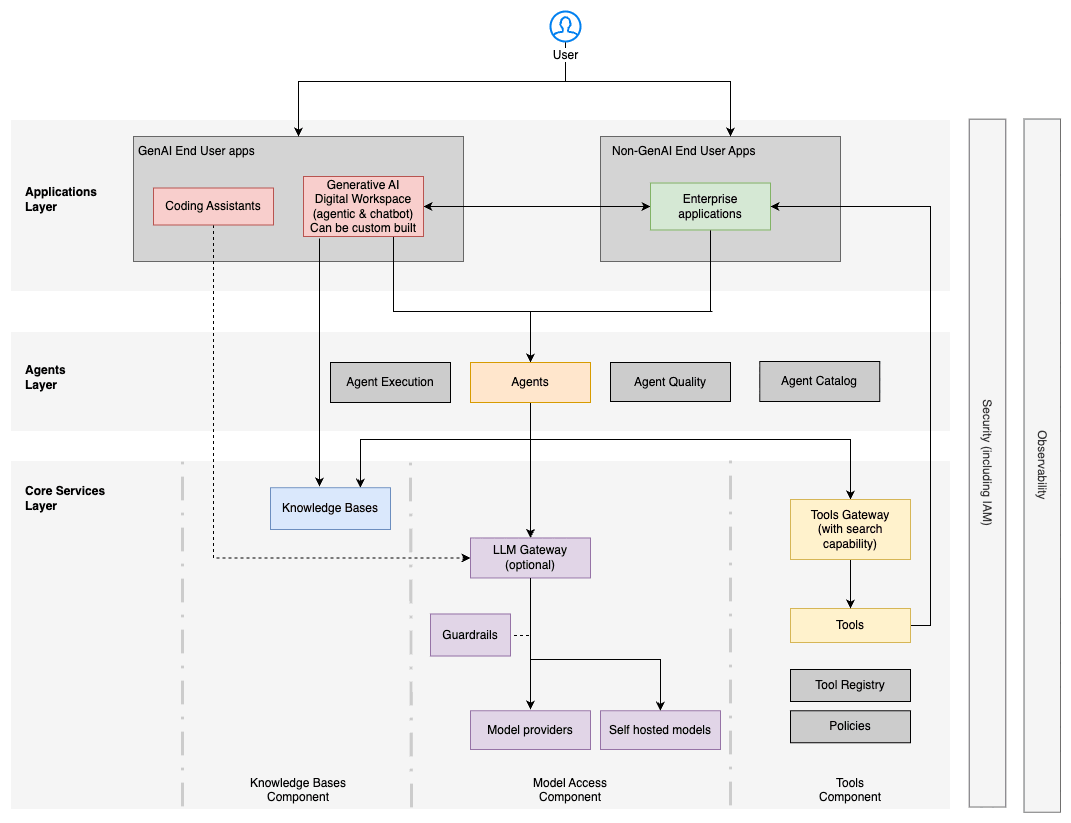
Source: AWS Prescriptive Guidance, Agentic AI architecture in the enterprise. The diagram is one vendor reference architecture, not a mandatory stack.
Mark the Trust Boundaries
A trust boundary is a point where data or authority moves between contexts with different owners, permissions, or assumptions. Common boundaries include:
- user input entering the application;
- private documents entering an index;
- retrieved text entering the model context;
- model output becoming executable arguments;
- a third-party model receiving company data;
- an action crossing into CRM, HR, finance, or messaging systems;
- logs moving into analytics or support tools.
At each boundary, ask what must be authenticated, authorized, minimized, validated, logged, retained, and recoverable.
Capability, Permission, and Autonomy
Risk grows along three independent dimensions:
- Capability: which operations are available?
- Permission: which data and systems may those operations access?
- Autonomy: how many decisions or actions can occur without human review?
A support assistant may need to read an order but not modify it. A refund tool may need a transaction limit and explicit approval. A batch workflow may need a stop condition even if each individual operation is low risk.
Guardrails Need Layers
A system prompt is an instruction, not an authorization boundary. Combine controls at the appropriate layer:
| Layer | Example control |
|---|---|
| Interface | Confirm high-impact actions and explain consequences |
| Application | Limit workflow steps, retries, and allowed operations |
| Tool contract | Validate typed inputs and reject unsupported fields |
| Identity and access | Apply least privilege and tenant-aware authorization |
| Data | Filter by permissions before retrieval and minimize sensitive fields |
| Output | Encode, validate, cite, or route uncertain results to review |
| Operations | Log actions, alert on anomalies, rate-limit, and support rollback |

Source: OWASP GenAI Security Project, LLM01: Prompt Injection.
Prompt injection is an architectural concern because untrusted instructions can arrive through user input, retrieved documents, web pages, emails, or tool results. The design must assume that natural-language context can be hostile.
Check Your Understanding
Question: An onboarding assistant only needs to explain HR tasks. Its integration can also delete employee records. Is a prompt saying “never delete” enough?